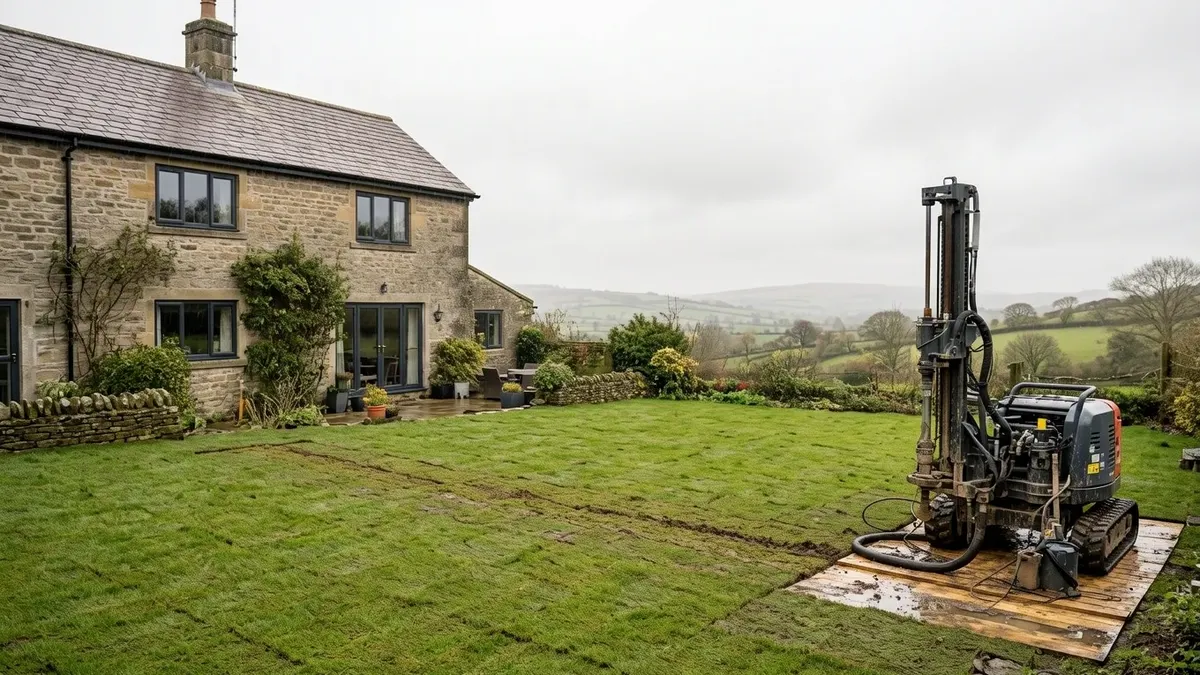
- Typical cost: the median ground source heat pump funded under the Boiler Upgrade Scheme in 2025/26 cost £26,200 installed. Air source cost £13,000 (BUS statistics).
- Trench vs borehole: the Energy Saving Trust puts a trench system at around £15,000. Boreholes cost “considerably more”, often £10,000 or more on top.
- Grant: £7,500 off in England and Wales, or £9,000 if you're replacing oil or LPG and have no mains gas (until March 2027). That takes the median to about £17,000–£19,000.
- Running costs: about £670–£900 a year for a typical home's heat at today's price cap, compared with about £1,065 on gas. The big savings come from replacing oil, LPG or direct electric heating.
- Best fit: off-gas homes with land, self-builds and long-term owners. On mains gas, the case rests on comfort and carbon more than payback. Check your grants.
Ground source heat pumps are the most efficient way to heat most British homes. They are also the most expensive to install, and the hardest to price, because most of the cost is in the ground rather than in the box on the wall. This guide uses the government's own record of installations to show what people actually paid. It then works through running costs, the grant and two real-world examples, so you can judge a quote yourself.
If you are comparing with air source, our heat pump cost guide covers air source pricing. For every funding route, see heat pump grants.
How much does a ground source heat pump cost in 2026?
The best evidence comes from the Boiler Upgrade Scheme (BUS). Every installation it funds reports a price to Ofgem, and DESNZ publishes the results. For installations paid in the 2025/26 financial year, the median ground source heat pump cost £26,200 across 367 installs. The median air-to-water (air source) heat pump cost £13,021 across 30,590 installs (BUS statistics, August 2026, Table A1.3A).
| What you're paying for | Typical share | Notes |
|---|---|---|
| Heat pump unit | £6,000–£12,000 | Indoor unit, usually a utility room or garage; sized to the home's heat loss |
| Ground loop: trenches | £3,000–£8,000 | Digging, pipe and backfill; needs a large, accessible garden |
| Ground loop: borehole(s) | £10,000–£20,000+ | Specialist drilling; depends on depth, geology and number of holes |
| Hot water cylinder & controls | £1,500–£3,000 | Usually needed if you currently have a combi boiler |
| Radiators / underfloor heating | £0–£5,000+ | Larger emitters let the pump run at a lower, more efficient flow temperature |
| Design, survey, commissioning | included or £500–£1,500 | MCS heat-loss calculation is required |
Indicative 2026 component ranges, before grant and at 0% VAT. Your quote should itemise these. Totals vary widely by site; the median BUS-funded total was £26,200.
The Energy Saving Trust gives the same picture from a different angle. It says installation is “typically around £15,000 if your ground loop is buried in trenches”, and that a borehole makes it “considerably more” (Energy Saving Trust).
Ground source heat pump cost by size
Bigger homes need bigger heat pumps and longer ground loops, so cost rises with capacity. Here is the median installed price by size band for BUS-funded ground source installs in 2025/26:
| Home | Likely size | Median installed cost | After £7,500 grant |
|---|---|---|---|
| 2–3 bed, well insulated | 6–10kW | about £21,300–£21,700 | about £13,800–£14,200 |
| 3–4 bed detached | 10–14kW | about £25,500–£29,300 | about £18,000–£21,800 |
| Large or older farmhouse | 14–20kW | about £31,200–£32,800 | about £23,700–£25,300 |
| Very large / multiple buildings | 20kW+ | about £49,400 | about £41,900 |
Median figures from BUS 2025/26 data, rounded. The size you need comes from the installer's room-by-room heat-loss survey, not from bedroom count. Insulating first can drop you a band.
Borehole vs trench: which ground loop and what it costs
The ground loop is the pipework that collects heat from the earth. A few metres down, the ground stays at a fairly steady temperature, around 10°C, all year. That stability is why ground source outperforms air source on the coldest days. There are two ways to lay the loop:
| Horizontal (trenches) | Vertical (borehole) | |
|---|---|---|
| How it works | Pipe or “slinky” coils laid in trenches about 1–2m deep | One or more holes drilled typically 50–200m deep |
| Land needed | A lot: as a rough rule, two to three times the heated floor area | Very little; a drilling rig needs access to a small patch |
| Cost | Cheapest: the EST benchmark is about £15,000 all-in | Highest: drilling often adds £10,000+ over trenches |
| Disruption | Whole garden dug up, then re-turfed | A few days of drilling noise and mud |
| Good for | Rural homes, farms, big gardens | Smaller plots, gardens with mature planting, urban sites |
Ranges are indicative. Geology matters: drilling through hard rock is slower and dearer, and some sites need a geological survey first.
There's a third option growing in popularity: shared ground loops, where a street or block shares a set of boreholes and each home has its own heat pump. The Boiler Upgrade Scheme statistics track these separately, and the per-home cost of joining an existing network can be far lower than drilling your own.
Most closed-loop installations are permitted development and don't need planning permission. Listed buildings and conservation areas are exceptions, so check with your council (Energy Saving Trust). Open-loop systems, which pump groundwater rather than circulating sealed fluid, normally need permits from the environmental regulator.
See which heat pump grants you can claim
The Boiler Upgrade Scheme is open to most homeowners in England and Wales. Some households can get more through ECO4 or the Warm Homes: Local Grant. Check your postcode in 60 seconds.
The Boiler Upgrade Scheme grant: £7,500, or £9,000 off oil and LPG
The Boiler Upgrade Scheme gives £7,500 towards a ground source heat pump in England and Wales. The same amount applies to air source. Until March 2027 you can get an extra £1,500, making £9,000, if your home is heated by oil or LPG and you don't have a mains gas connection (GOV.UK — Boiler Upgrade Scheme: what you can get). Funding has been committed through to 2029/30 (BUS business case, DESNZ).
The main rules, from GOV.UK:
- You own the property. That includes second homes and homes you rent out, so landlords qualify (see our landlord EPC C guide).
- You're replacing fossil fuel heating, such as oil, gas, LPG or electric.
- Most new builds are excluded, but self-builds can qualify.
- Your MCS-certified installer applies for the grant and takes it off your bill. The heat pump must be installed and commissioned within 120 days of the application.
Two more savings stack on top. Heat pumps are zero-rated for VAT until 31 March 2027 (HMRC VAT Notice 708/6). And households on qualifying benefits may get a heat pump funded as part of an ECO4 package, which runs to 31 December 2026. In England, low-income homes rated EPC D–G may get one through the Warm Homes: Local Grant. Ground source is rarely the measure those schemes choose, though, so don't count on it. Off-gas homes should also read our guide to heat pump grants for oil and LPG homes.
In Scotland, Home Energy Scotland offers its own grant and interest-free loan. In Northern Ireland there's currently no dedicated heat pump grant (Energy Saving Trust).
Running costs: ground source heat pump vs gas
A heat pump's running cost depends on one number: its seasonal coefficient of performance (SCOP), the units of heat it delivers for each unit of electricity. Well-designed ground source systems commonly achieve a SCOP of 3.5 to 4 or better; poorly designed ones fall to around 3. Here is what that means for a typical home needing 10,200 kWh of heat a year, which is about what a gas boiler produces from 12,000 kWh of gas.
On these numbers a good ground source system saves about £170–£400 a year against gas. The top of that range assumes you remove the gas meter and stop paying its standing charge. Against direct electric heating the saving is around £1,800–£2,000 a year. Heat-pump-specific electricity tariffs with cheaper overnight or off-peak rates can widen the gap further.
Worked examples
An oil-heated farmhouse in rural Herefordshire
A four-bedroom stone farmhouse with a large paddock, heated by an old oil boiler, needing about 18,000 kWh of heat a year. The survey recommends a 12–14kW ground source heat pump with horizontal slinky trenches across the paddock.
Compare that £1,354 with what you paid for roughly 2,000 litres of heating oil over the last 12 months, plus boiler servicing. With a paddock to trench, this home avoids the cost of drilling. It also qualifies for the higher £9,000 grant, the strongest combination for ground source.
A 1970s detached house in Harrogate on mains gas
A four-bed detached house with a mid-sized garden, using 16,000 kWh of gas a year (about 13,600 kWh of heat). The garden is too small for trenches, so it needs a borehole.
DESNZ estimates a replacement gas boiler costs about £3,500 (BUS business case). The extra £15,200 would take decades to recover at today's prices. Here, ground source is a choice for comfort, carbon and future-proofing, not a quick payback. An air source heat pump at roughly half the cost is usually the more economic option for this house.
Ground source vs air source heat pumps
| Ground source | Air source | |
|---|---|---|
| Median installed cost (BUS 2025/26) | £26,200 | £13,021 |
| Grant (England & Wales) | £7,500 (£9,000 off oil/LPG) | £7,500 (£9,000 off oil/LPG) |
| Winter efficiency | Steady: the ground stays around 10°C | Falls in freezing weather |
| Outdoor unit | None; nothing to hear outside | Fan unit on an outside wall or the ground |
| Garden disruption | Major (trenches) or moderate (borehole) | Minimal |
| Lifespan | Ground loops last for decades; the pump unit around 20 years | Typically 15–20 years |
| Best for | Larger, off-gas homes with land; self-builds; shared loops | Most homes, including terraces and semis |
Is a ground source heat pump worth it?
- You're off the gas grid and heat with oil, LPG or direct electric. You get the biggest running-cost savings and the £9,000 grant for oil and LPG.
- You have land for trenches, which avoids drilling.
- You're building or extending, so groundworks and underfloor heating can be planned in.
- You'll stay 15+ years, long enough for the efficiency gains to compound.
- You're on mains gas with a small garden. Borehole costs, set against modest savings, make air source the better value.
- The house is poorly insulated. Insulate first; it cuts the size and cost of the system. Grants may cover it: see insulation grants.
Five ways to cut the cost
- Get the right grant. Claim £9,000, not £7,500, if you heat with oil or LPG and have no mains gas. That top-up runs until March 2027.
- Install before 31 March 2027 to keep 0% VAT. After that the rate is due to rise to 5%.
- Insulate first. A smaller heat pump needs a shorter loop. Each size band down can save thousands.
- Trench if you can. If you have the land, horizontal loops avoid the biggest cost line.
- Get three MCS quotes, each itemised by unit, ground works, cylinder and emitters, with a heat-loss calculation and an estimated SCOP. The EST recommends at least three quotes from MCS-certified installers.
Start with the grant check
Find out whether you qualify for the Boiler Upgrade Scheme, ECO4 or the Warm Homes: Local Grant before you get quotes.